When you need a custom part made, two technologies come up again and again: FDM 3D printing and CNC machining. Both can produce high-quality, functional parts. Both are available as professional services. And at first glance, both might seem like they solve the same problem.
But they work in fundamentally different ways — and each one has a specific set of use cases where it clearly wins. Choosing the wrong process can cost you time, money, and quality. This guide breaks down exactly how each technology works, where it excels, and how to make the right call for your project.
How Each Process Works
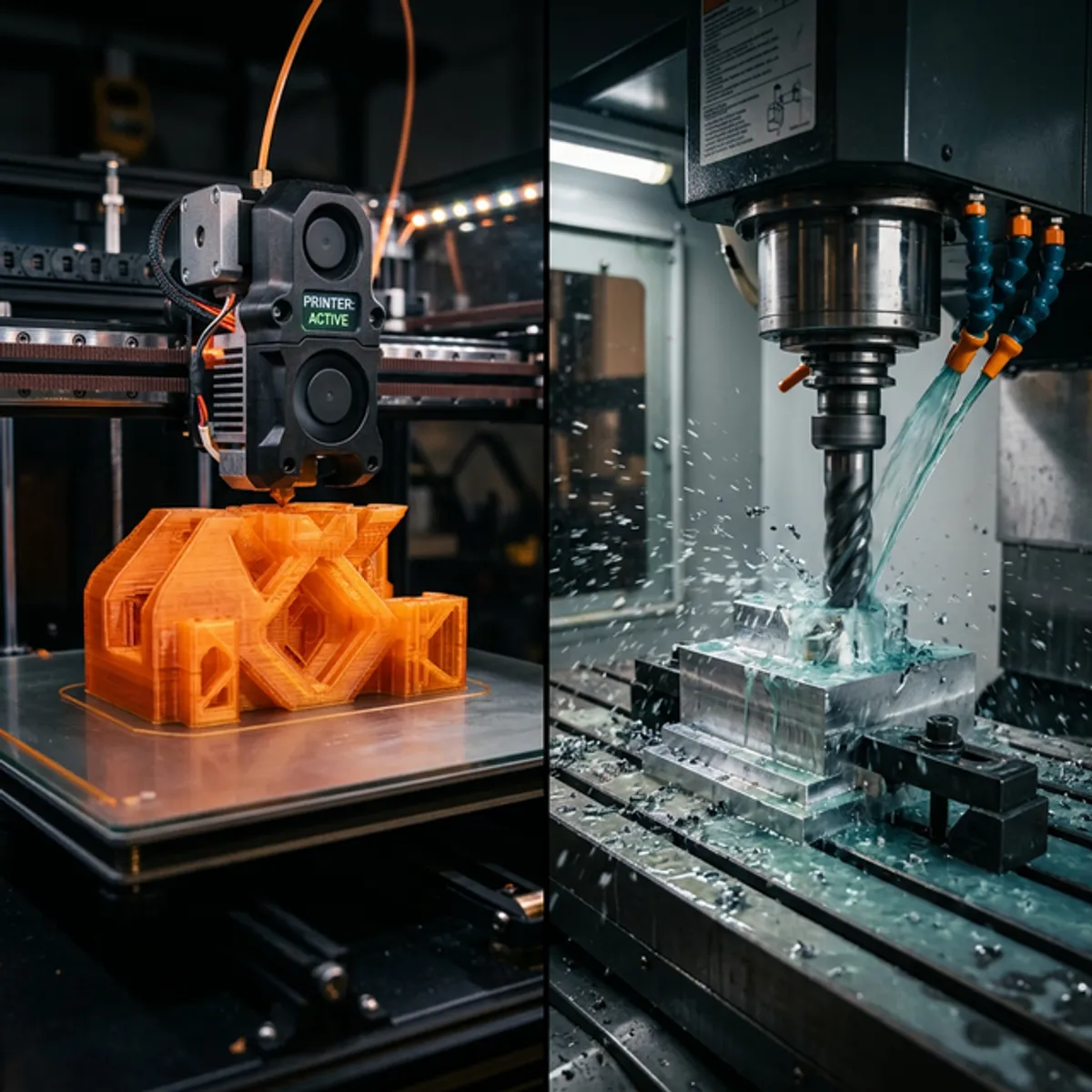
Additive vs. subtractive — the fundamental difference.
FDM 3D printing builds parts by depositing melted thermoplastic filament layer by layer from the bottom up. Material is only added where it's needed — nothing is wasted in the process. The workflow is: slice the 3D model, heat & extrude filament along the programmed path, build layer by layer until complete, then post-process (remove supports, sand, prime, or paint).
CNC machining starts with a solid block of material — metal, plastic, or wood — and removes material using rotating cutting tools guided by precision computer instructions. The workflow is: CAM programming to generate toolpaths, secure the stock material, cut & mill along precise paths at high speed, then finish (deburr, anodize, coat, or polish).
Where Each Process Wins
Neither technology is universally better — context is everything.
Complex Geometry & Internal Features: FDM can produce undercuts, internal channels, lattice structures, and organic shapes that would be impossible or extremely expensive to machine. FDM Wins.
Tight Tolerances & Precision Fits: When parts need to fit together with very tight tolerances — threaded holes, bearing seats, press fits — CNC is the clear choice. CNC Wins.
Low-Volume Prototyping & Quick Iteration: No tooling setup, no minimum order quantity, no programming lead time. FDM can turn around a prototype in hours. FDM Wins.
Metal Parts & Structural Load-Bearing: If your part needs to be aluminum, steel, or brass — and will carry real mechanical loads — CNC machining is the answer. CNC Wins.
Large Parts & Build Volume: For parts larger than a breadbox, FDM is often the only viable choice unless you have access to industrial-scale CNC mills. FDM Wins.
Surface Finish & Aesthetics: If the part needs to be perfectly smooth, clear, or have a specific texture right off the machine, CNC's rotating cutters deliver a superior finish. CNC Wins.
How to Choose the Right Process
Answer these questions to find your best fit.
Choose FDM 3D Printing if: you need a prototype fast and at low cost, your part has complex geometry or internal features, you're working with plastics or composites, or you need to iterate on the design multiple times.
Choose CNC Machining if: your part must be made from metal, you need tight tolerances (±0.05mm or better), the part will carry high mechanical loads, or surface finish and aesthetics are critical.
Consider Using Both (Hybrid Approach) when: you need a plastic prototype before committing to a metal production part, your assembly has both plastic housing and metal inserts, or you want to validate design before expensive CNC programming.
Both Services. One Team.
Atlas3Dprints offers professional FDM printing and CNC machining under one roof.
FDM 3D Printing: Up to 350×350×350mm build volume. PLA, PETG, ABS, and engineering-grade materials.
CNC Machining: Milling, turning, and laser cutting. Aluminum, steel, brass, and acrylic. Tight tolerances.
Frequently Asked Questions
Can FDM 3D printing replace CNC machining entirely?
Not for most production applications. FDM is excellent for prototyping and complex geometries — but it cannot match the tolerances or surface quality of CNC-machined metal parts.
Which process is cheaper for a one-off prototype?
FDM is almost always cheaper for a single prototype. There's no tooling cost and programming lead time is minimal compared to the CAM setup required for CNC.
Which process has faster lead times?
FDM is much faster for simple iterations. A 3D print can be ready in hours, while CNC typically takes 1-5 days due to setup, toolpath optimization, and material preparation.
Is material waste a major factor?
Yes. FDM is additive and produces near-zero waste. CNC is subtractive and can result in 60-90% material waste for complex parts, which significantly impacts the cost of expensive metals.
Can I combine both for a single project?
Absolutely. Many of our clients 3D print housings and brackets but CNC machine the high-wear internal components or precision mounting plates.
Not Sure Which Process You Need?
Send us your design and project requirements. Our team will recommend the right manufacturing process — or a combination of both.
Request a Free Quote